
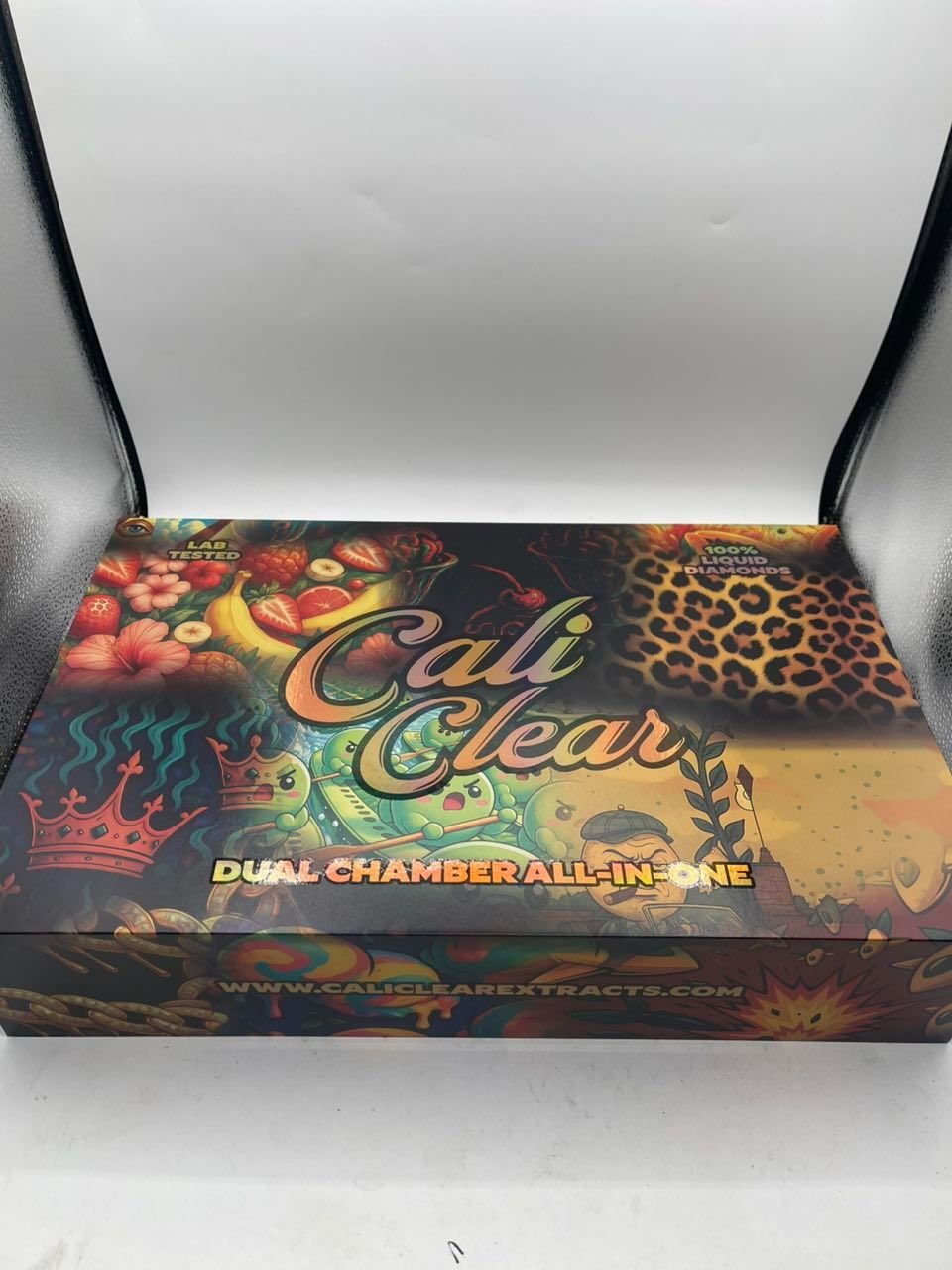


CALI CLEAR SELECT 2G DISPOSABLE DUAL CHAMBER ALL-IN-ONE
Price range: $30.00 through $1,500.00
The CALI CLEAR SELECT 2G Disposable Dual Chamber All-in-One is engineered around a dual-reservoir system integrated into a compact unibody chassis. Its operational behavior depends on coordinated electrical regulation, thermal synchronization, and material tolerances that support two isolated heating environments within a single device. Because dual-chamber hardware introduces complex internal load demands, the system incorporates high-stability materials, temperature-resistant structural supports, and safety-regulated circuitry to maintain consistency across multiple operational cycles.
Description
CALI CLEAR SELECT 2G DISPOSABLE DUAL CHAMBER ALL-IN-ONE — Engineering Design Blueprint, Material Composition Analysis, and Dual-Channel Structural Framework
Structural Architecture, Dual-Chamber Load Engineering, and Materials-Science Framework
The CALI CLEAR SELECT 2G Disposable Dual Chamber All-in-One is constructed upon a rigid structural architecture that prioritizes mechanical stability, thermal isolation, and internal load distribution across two independent reservoirs. Because both chambers operate simultaneously or sequentially depending on circuit activation, the structural framework must withstand increased thermal gradients, higher mass density, and multi-directional mechanical stress. Therefore, the engineering process begins with material selection, structural modeling, and finite-element analysis (FEA) simulations that measure deformation behavior under load cali clear select 2g dual chamber.
1.1 Unibody Chassis Engineering
The device’s external housing is built from high-density polycarbonate (PC) or polyetherimide (PEI) compounds due to their elevated impact tolerance, low thermal conductivity, and dimensional stability under heat. In some cases, anodized aluminum alloys are used to increase rigidity while maintaining low mass. Each housing material undergoes thermal expansion coefficient testing, ensuring structural uniformity under heating cycles generated by the dual-coil assemblies.
The chassis follows a unibody compression-resistant model, which distributes mechanical load uniformly across the frame. Furthermore, ribbing structures are integrated along the interior walls to increase torsional rigidity. These ribs function as reinforcement nodes that minimize chassis flex, especially when both chambers heat simultaneously.
1.2 Dual-Chamber Compartment System
Internally, the device features two independent reservoir compartments separated by a high-temperature polymer partition. This partition is critical because dual heating modules produce differential thermal loads, and without proper isolation, heat conduction may compromise material stability. Therefore, the partition utilizes a glass-fiber-reinforced polymer (GFRP) or mica-based composite, which exhibits minimal deformation across thermal cycles.
Each chamber compartment includes:
-
Precision-molded reservoir wells
-
Heat-shield interfaces
-
Mechanical retention tabs
-
Shock-absorption posts
These features ensure that reservoirs remain seated consistently without vibration-induced displacement. Additionally, the compartments incorporate pressure equalization vents that counteract pressure gradients during heating.
1.3 Finite-Element Analysis and Stress-Load Modeling
Before mass production, engineers conduct finite-element simulations to evaluate:
-
Shear stress near the dual heating elements
-
Torsional stress across the unibody structure
-
Thermal propagation patterns
-
Load distribution across the central partition
-
Mechanical resonance during airflow activation
Simulation results guide modifications to internal rib thickness, partition density, and chassis wall curvature. Moreover, high-stress zones are reinforced with thicker polymer nodes or metallic insert plates depending on output requirements.
1.4 Reservoir Material Compatibility
Because the device houses two reservoirs, the materials must handle:
-
Solvent interaction
-
Long-term storage conditions
-
Thermal exposure during activation
Therefore, reservoir liners typically consist of:
-
Borosilicate micro-tubing
-
Medical-grade polymer sleeves
-
Heat-stable elastomer seals
These materials prevent leaching, swelling, and structural distortion during temperature elevation. Additionally, liners undergo chemical resistance testing, including solvent-compatibility assays and accelerated aging trials.
1.5 Mechanical Partition and Thermal Isolation System
The mechanical partition is engineered with a laminated insulation core, which minimizes heat transfer between chambers. This insulation layer may include:
-
Ceramic fiber
-
Expanded mica
-
Aerogel-reinforced polymer composites
Because the heating modules generate localized heat up to several hundred degrees Celsius, thermal isolation prevents cumulative heat buildup in the adjacent chamber, thereby ensuring stability.
1.6 Battery Housing and Load Anchoring
The dual-chamber format requires a centralized battery housing built from flame-resistant polymer (FR-PC or FR-ABS). The battery mounts are reinforced with:
-
Compression brackets
-
Anti-vibration pads
-
Shock dampeners
These components reduce kinetic transfer during movement or impact events. Additionally, the battery housing includes thermal isolation walls that prevent heating elements from conducting heat to the power cell.
1.7 Airflow Channeling and Mechanical Reinforcement
Each chamber has an independent airflow path that merges at a convergence node near the mouthpiece. To avoid turbulence and pressure imbalance, airflow channels are engineered with:
-
Optimized curvature profiles
-
Low-drag internal surfaces
-
Symmetrical cross-sectional geometry
Computational fluid dynamics (CFD) simulations determine optimal airflow speed, pressure, and laminar flow consistency. Consequently, channels are molded with micron-level precision, reducing internal turbulence and ensuring stable airflow.
Reinforcement inserts are added along airflow tunnels to:
-
Prevent collapse under vacuum force
-
Reduce deformation under heat
-
Maintain smooth channel geometry
1.8 Structural Fastening and Internal Assembly
Internal components are secured using:
-
Ultrasonic weld joints
-
Mechanical locking tabs
-
Heat-resistant adhesives
-
Micro-threaded fasteners (in aluminum variants)
Because ultrasonic welding creates molecular bonding between polymer layers, it enhances structural integrity without introducing external hardware stress points. Additionally, locking tabs align components accurately, preventing rotational drift or internal movement during device activation.
1.9 Surface Treatments and Material Finishing
Finally, the chassis undergoes surface finishing that includes:
-
Anti-abrasion coatings
-
Matte-texture layering
-
Anti-fingerprint polymer finishes
-
UV-resistant overlays
These treatments ensure that exterior surfaces maintain structural and aesthetic stability under prolonged handling.
Electrical System Architecture, Dual-Module Heating Engineering, and Sensor-Regulated Operational Control
The internal electrical system of the CALI CLEAR SELECT 2G Disposable Dual Chamber All-in-One is engineered as a multi-layered architecture that coordinates power regulation, heating efficiency, and sensor activation across two isolated chambers. Because a dual-module platform requires twice the thermal load management and symmetrical energy distribution, the circuit is designed to minimize resistance fluctuations, voltage instability, and thermal drift during operation. Consequently, each functional element—from the microcontroller to the heating elements—interacts as part of an integrated electrical network that prioritizes stability, continuity, and safety.
2.1 Printed Circuit Board (PCB) Construction and Layering
The PCB serves as the central framework that binds the electrical system together. It is fabricated from FR-4 high-temperature composite laminate, chosen for its dielectric strength and thermal endurance. Additionally, the board includes:
-
Multi-layer copper pathways for reduced resistance
-
Insulating resin layers for thermal isolation
-
Reinforced solder joints engineered for mechanical vibration resistance
Because the device uses a dual-heating configuration, the PCB incorporates mirrored circuit pathways, ensuring that each chamber receives equivalent current distribution. This symmetrical layout reduces the risk of uneven heating or power imbalance.
Copper Thickness and Conductivity Optimization
To maintain stable conductivity, the PCB uses 2 oz copper thickness, which is thicker than standard consumer-grade boards. This reduces heat buildup along conductive traces and supports higher continuous current loads. Conductivity modeling is performed during development to verify that:
-
Voltage drops remain within tolerance
-
Trace expansion under heat remains minimal
-
Thermal distribution across the board stays uniform
These modeling results influence trace width, pad placement, and grounding strategies.
2.2 Microcontroller Unit (MCU) and Firmware Logic
At the core of the electrical architecture is a miniature Microcontroller Unit (MCU) programmed to monitor activation signals, regulate energy flow, and manage safety protocols. The MCU processes sensor input, adjusts pulse-width modulation (PWM), and prevents thermal overstress.
Key MCU Functions Include:
-
Real-time heating control for each coil
-
Dual-channel power balancing
-
Fault detection for short-circuits or voltage spikes
-
Thermal overload prevention
-
Battery protection logic
Additionally, the MCU ensures that airflow or pressure activation signals are interpreted accurately, even during rapid inhalation cycles. Its firmware uses feedback loop algorithms that measure resistance changes in heating elements, allowing the system to adjust power instantaneously.
2.3 Battery Module, Load Support, and Safety Mechanisms
The device uses a high-drain lithium-ion or lithium-polymer cell engineered for stable discharge behavior cali clear select 2g dual chamber. Because dual-chamber heating requires higher peak current, the battery module integrates:
-
Over-current protection (OCP)
-
Over-discharge protection (ODP)
-
Short-circuit protection (SCP)
-
Thermal cutoff circuitry (TCC)
The power cell sits inside a flame-resistant housing constructed from FR-graded polymer, which prevents heat transfer from the coils to the battery cali clear select 2g dual chamber. Additionally, compression brackets and vibration-dampening pads secure the battery, reducing mechanical strain and preventing connection fatigue cali clear select 2g dual chamber.
Battery Contact Engineering
Battery terminals use nickel-plated spring contacts that maintain tension and ensure continuity under vibration. Furthermore, these terminals undergo endurance testing to confirm that long-term compression does not degrade conductivity.
2.4 Dual Heating Assemblies and Thermal Engineering
Each chamber uses an independent heating assembly designed for rapid activation and controlled thermal behavior. The assemblies include:
-
Nickel-chromium alloy coils or mesh heaters
-
High-temperature ceramic supports
-
Thermal insulation shields
Because the heating output must remain stable, electrical resistance values are calibrated during coil winding. Additionally, each heater includes thermal buffering layers that reduce heat migration into adjacent components.
Coil Resistance and Heat Distribution
Engineers tune coil specifications through:
-
Resistance measurement
-
Heat-curve modeling
-
Temperature-rise simulations
-
Long-cycle endurance trials
These procedures ensure that both chambers heat uniformly under equal power application.
Thermal Shielding Architecture
To prevent heat overlap between chambers, insulation systems use:
-
Mica composite barriers
-
Ceramic fiber pads
-
Aerogel-infused polymer sheets
These materials maintain structural integrity even when chamber temperatures rise significantly.
2.5 Airflow-Activated Pressure Sensor System
The device activates through a pressure-sensing switch, which detects negative pressure created by inhalation. This sensor is engineered with:
-
Silicone-diaphragm construction
-
High-sensitivity micro-switches
-
Air-path alignment channels
When airflow enters either or both chambers, the pressure drop causes the diaphragm to deform slightly, triggering an electrical signal to the MCU.
Sensor Calibration and Response Speed
The sensor system undergoes testing to ensure:
-
Minimal activation delay
-
Uniform response across both chambers
-
Stability under rapid suction pulses
-
No false activation under environmental pressure shifts
Because dual chambers share a unified activation command, the MCU must synchronize heater activation instantly to maintain electrical balancecali clear select 2g dual chamber .
2.6 Power Distribution, PWM Regulation, and Load Management
The MCU uses pulse-width modulation (PWM) to regulate coil temperature. PWM controls the amount of energy delivered to heating elements by adjusting voltage pulses. This method creates:
-
More consistent heating
-
Reduced coil stress
-
Lower risk of overheating
-
Energy-efficient operation
The dual-chamber configuration includes independent PWM channels, allowing each heater to receive controlled, isolated power.
Current Balancing Algorithms
To avoid uneven thermal output, the MCU monitors coil resistance in real time. When resistance shifts due to heat expansion, firmware algorithms adjust the duty cycle, ensuring stable temperature across both chambers.
2.7 Safety Protocols and System Redundancies
Because nicotine devices require stringent safety mechanisms, the electrical system includes several redundancies cali clear select 2g dual chamber:
-
Dual-layer insulation on wiring
-
Grounding loops integrated into the PCB
-
Fuse-protected power rails
-
Short-detection circuitry
Additionally, the MCU interrupts power instantly when abnormalities occur.
Thermal Runaway Prevention
Sensors monitor:
-
Coil temperature patterns
-
Battery temperature trends
-
Resistance spikes
If values exceed programmed thresholds, the MCU stops power delivery to prevent device failure.
2.8 Electromagnetic Interference (EMI) Shielding
The PCB includes EMI-protective features such as:
-
Copper shielding grids
-
Ground-plane expansion
-
Ferrite beads on power lines
These components reduce noise interference and ensure sensor accuracy.
2.9 Wiring Infrastructure and Mechanical Routing
High-temperature silicone-insulated wires connect:
-
Battery → PCB
-
PCB → Dual heating elements
-
Sensor → MCU
These wires run within molded routing channels that prevent pinching, abrasion, or vibration-induced fatigue. Moreover, adhesive anchors and clamp brackets secure the wiring to the chassis cali clear 2g disposable.
Airflow Engineering, Fluid-Dynamic Channel Modeling, and Dual-Chamber Pressure Regulation Architecture
The airflow system inside the CALI CLEAR SELECT 2G Disposable Dual Chamber All-in-One is engineered to manage two independent vapor pathways while maintaining stable pressure distribution and predictable aerodynamic flow cali clear select 2g dual chamber. Because the device integrates two separate heating modules, it must accommodate parallel airflow streams that eventually converge into a unified output channel. Consequently, internal channel geometry, wall surface characteristics, and pressure-response calibration must be precisely controlled to prevent turbulence, flow imbalance, or cross-chamber interference. Through computational fluid dynamics (CFD), engineers refine the airflow system so that both chambers exhibit nearly identical aerodynamic performance, even under varying operational conditions cali clear select 2g dual chamber.
3.1 Dual Intake Channel Geometry and Structural Formation
Each chamber contains its own independent intake duct, which begins at the bottom of the device near the pressure-sensor cavity. These ducts are formed through precision injection molding of high-strength polymer. Additionally, both ducts maintain a symmetrical curvature profile, ensuring predictable airflow resistance across both sides.
Engineering Requirements for Intake Geometry
To maintain stable internal flow cali clear select 2g dual chamber, intake channels must satisfy several mechanical requirements:
-
Laminar-flow bias to reduce internal drag
-
Optimized curvature radius to minimize turbulence
-
Uniform cross-sectional area to maintain consistent velocity
-
High-temperature dimensional stability to prevent warping
The intake structure is molded with micron-level tolerances, which ensures identical airflow behavior between chambers. Furthermore, internal reinforcement ribs prevent channel deformation caused by heat expansion during heater activation cali clear select 2g dual chamber.
3.2 Airflow Path Material Selection and Surface Conditioning
The internal surfaces of the airflow pathways are constructed from heat-stable, low-porosity polymers designed to resist thermal expansion. Because airflow passes near heated components, material selection must account for cali clear disposable:
-
Thermal resistance
-
Consistent surface smoothness
-
Chemical stability
-
Structural rigidity
After molding, channels undergo surface conditioning, which may include micro-polishing or surface-coating treatments that reduce surface roughness cali clear select 2g dual chamber. This minimizes friction and supports laminar flow cali clear select 2g dual chamber. Additionally, surface conditioning reduces the likelihood of condensation accumulation or particulate adhesion cali clear select 2g dual chamber.
3.3 CFD Modeling and Aerodynamic Optimization
Engineers apply computational fluid dynamics to simulate airflow conditions during real-world operation. These simulations examine cali clear select 2g dual chamber:
-
Pressure differentials
-
Flow velocity
-
Turbulence formation
-
Heat transfer interactions
-
Air-vapor mixture behavior
-
Boundary-layer effects inside the ducts
To achieve optimal performance, CFD models evaluate multiple airflow scenarios, including:
-
Low-intensity airflow
-
Rapid suction cycles
-
Asymmetrical chamber activation
-
High-temperature chamber operation
Based on simulation findings cali clear select 2g dual chamber, engineers adjust the curvature, diameter, and angle of airflow pathways, ensuring both chambers produce consistent behavior during activation cali clear select 2g dual chamber.
3.4 Pressure Sensor Integration and Flow-Triggered Activation Control
The airflow system coordinates directly with a pressure-activated sensor. This component sits in a shared cavity positioned between the intake ducts. When either chamber experiences negative pressure, the sensor diaphragm flexes, generating an activation signal cali clear disposable 2g.
Sensor-Airflow Interaction Requirements
To maintain reliable activation, airflow into the sensor cavity must be:
-
Balanced across both channels
-
Fast-responding for high-pressure drops
-
Shielded from turbulence pockets
-
Consistent during long draw cycles
Therefore, engineers incorporate flow-conditioning vents around the sensor membrane cali clear select 2g dual chamber. These vents reduce disturbances, stabilize pressure waves, and help the sensor read airflow accurately cali clear select 2g dual chamber.
3.5 Dual Vapor Channel Engineering and Thermal Interaction Control
After passing through the intake ducts and heating modules, airflow transforms into heated vapor. This vapor must travel through two separate vapor channels before merging at the central junction cali clear select 2g dual chamber.
Vapor Channel Construction
Each channel incorporates:
-
High-temperature polymer or borosilicate liners
-
Heat-shielded outer walls
-
Pressure-resistant support ribs
-
Anti-condensation geometry
Furthermore, engineers design the vapor pathways with a slightly tapered diameter to maintain velocity while preventing condensation-induced blockage cali clear select 2g dual chamber.
Thermal Isolation Between Channels
Because each heater operates independently, vapor channels include cali clear select 2g dual chamber:
-
Ceramic thermal barriers
-
Reflective metal shields
-
Aerogel-reinforced polymer layers
These insulating structures prevent temperature crosstalk that could distort vapor density or pressure behavior cali clear select 2g dual chamber.
3.6 Aerodynamic Convergence Node and Flow Equalization Chamber
At the top of the dual vapor channels, both pathways merge into a convergence node. This region is one of the most complex aerodynamic structures inside the device cali clear select 2g dual chamber. Engineers use CFD simulations to shape this junction so that airflow merges smoothly without turbulence spikes cali clear select 2g dual chamber.
Key Convergence Node Features
The geometry includes:
-
Gradual merge angles to reduce back-pressure
-
Internal flow stabilizers that align directional flow
-
Low-turbulence transitional curvature
-
Symmetrical entry spacing from both chambers
To further stabilize convergence, engineers incorporate a flow equalization chamber—a small plenum that balances pressure and velocity between the left and right streams cali clear select 2g dual chamber.
Convergence Node Material Considerations
Because the convergence node experiences both heat and pressure fluctuations, it uses:
-
High-temperature polyetheretherketone (PEEK)
-
Radiant-blocking ceramic composites
-
Nickel-coated polymer reinforcements
These materials maintain dimensional uniformity under variable airflow velocities.
3.7 Mouthpiece Aerodynamics and User-Side Flow Stability
Airflow exits the convergence chamber and enters the mouthpiece flow tube, which is engineered with a streamlined profile that supports predictable flow. This tube includes:
-
A tapered acceleration zone
-
A laminar-flow stabilization segment
-
Anti-condensation ridges
-
Structural ribs that resist deformation
Moreover, the mouthpiece material—typically polycarbonate or PEEK—maintains rigidity under thermal cycling.
3.8 Pressure Regulation, Flow Symmetry, and Operational Tuning
Achieving consistent pressure across both chambers is one of the central engineering challenges. Therefore, engineers design the airflow system to naturally balance itself through:
-
Equal-length channels

-
Matched curvature
-
Mirror-image geometry
-
Precision calibrated intake vents
Furthermore, real-world test cycles measure:
-
Draw resistance
-
Pressure drop curves
-
Turbulence interference
-
Thermal-flow interactions
Test results lead to refinements in channel thickness, vent diameter, or inner curvature, improving operational uniformity.
3.9 Structural Durability Under Repeated Airflow Cycles
Because airflow exerts mechanical force on internal components, the system must withstand:
-
Repeated suction pulses
-
Pressure wave vibrations
-
Thermal expansion around channel walls
Therefore, reinforcement ribs and support beams anchor the airflow architecture throughout the chassis. Additionally, thermal-resistant adhesives secure liners and gaskets to maintain airtight flow under prolonged usage cali clear select 2g dual chamber.
Related products
-
Sale!

TURNS 2G DISPOSABLE HOT GIRL SUMMER
Price range: $30.00 through $1,500.00Select options This product has multiple variants. The options may be chosen on the product page -
Sale!

WHOLE MELT V6 EXOTIC EDITION
Price range: $30.00 through $1,500.00Select options This product has multiple variants. The options may be chosen on the product page -
Sale!

CRYBABY 2G DISPOSABLE LIVE RESIN LIQUID DIAMONDS
Price range: $25.00 through $1,400.00Select options This product has multiple variants. The options may be chosen on the product page -
Sale!

CLEAN CARTS 2G DISPOSABLE BLACK EDITION LIQUID DIAMONDS + LIVE RESIN
Price range: $30.00 through $1,550.00Select options This product has multiple variants. The options may be chosen on the product page
Reviews
There are no reviews yet.